

 Image 1 of 6
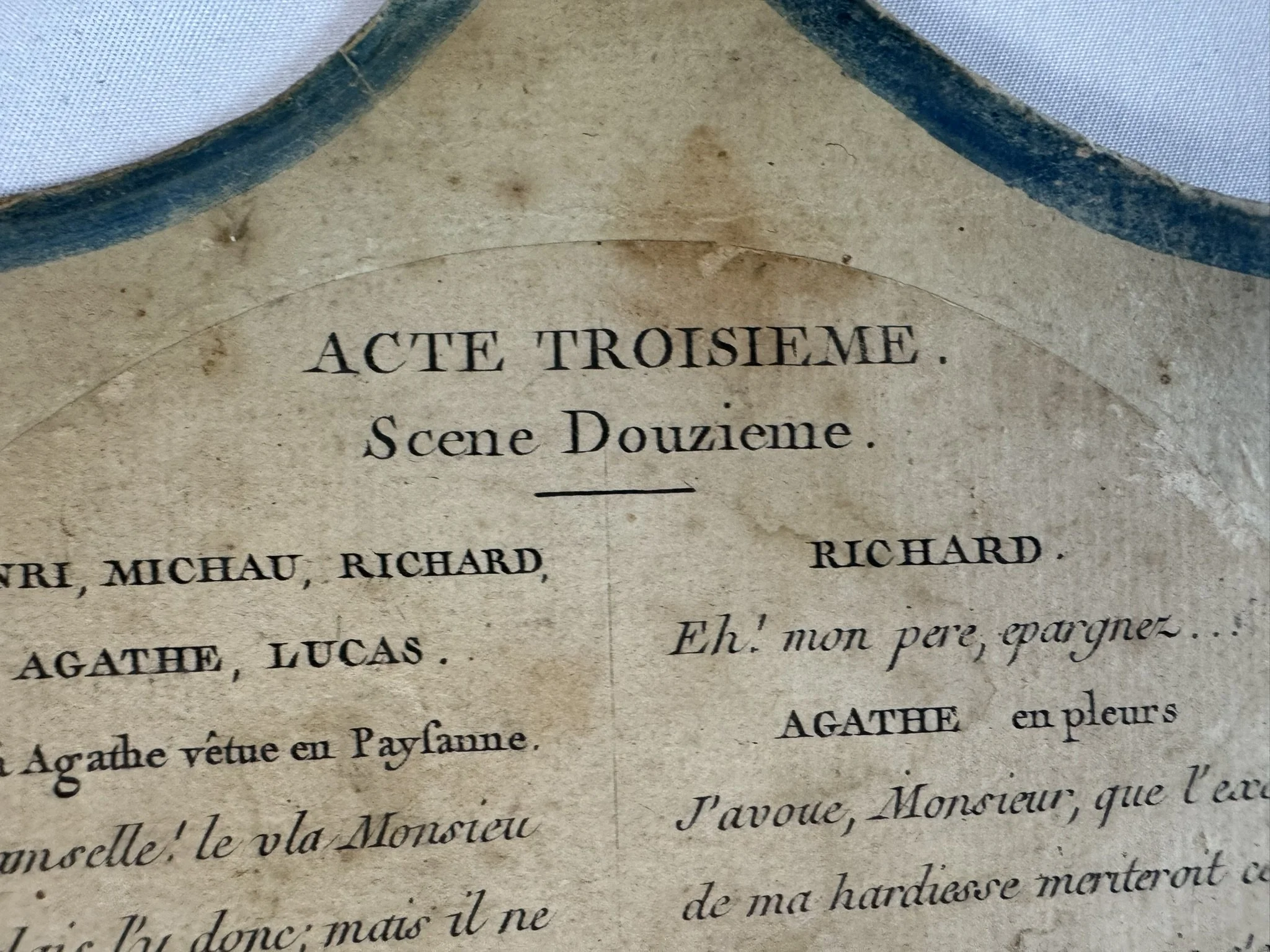 Image 2 of 6
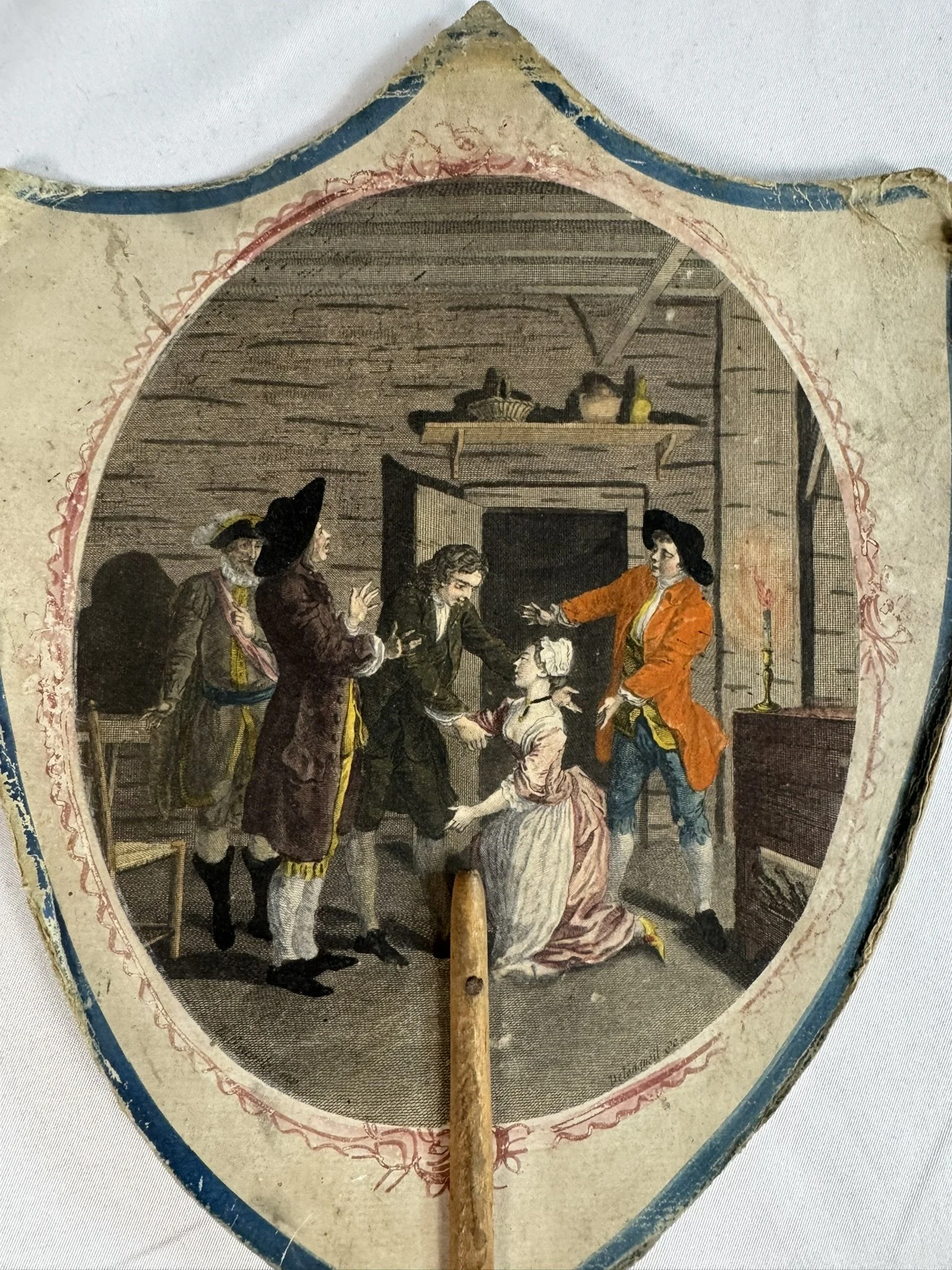 Image 3 of 6
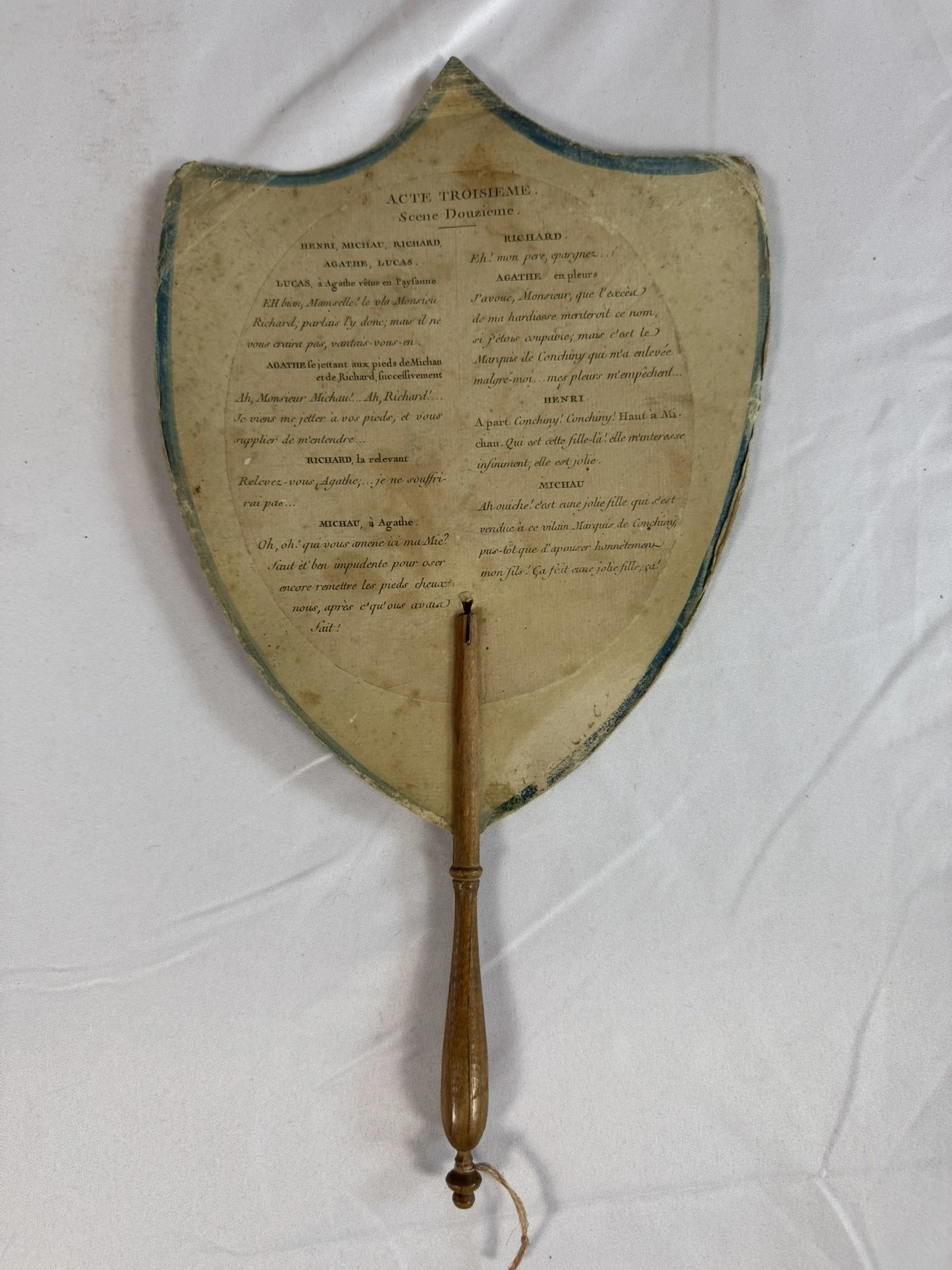 Image 4 of 6
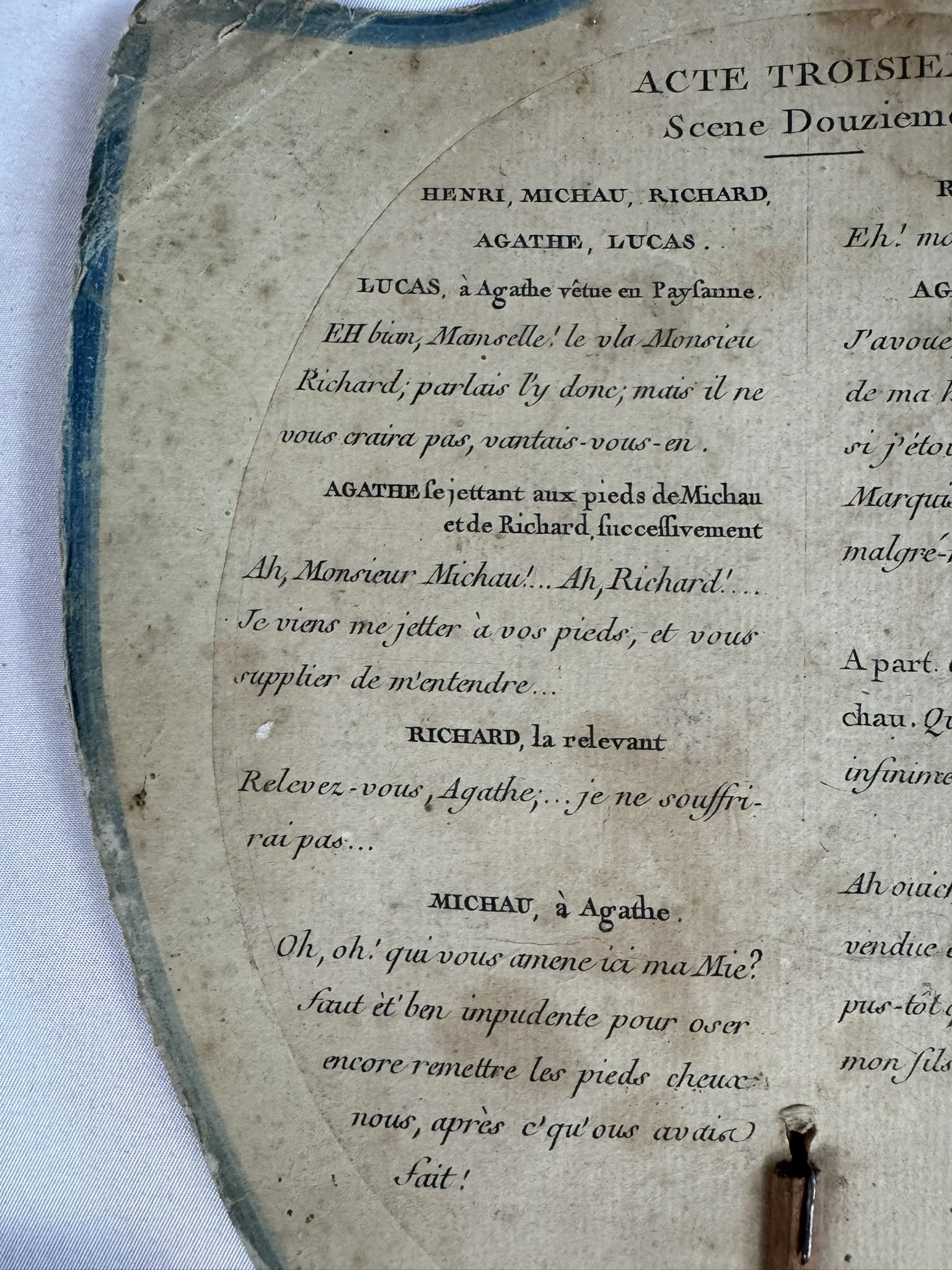 Image 5 of 6
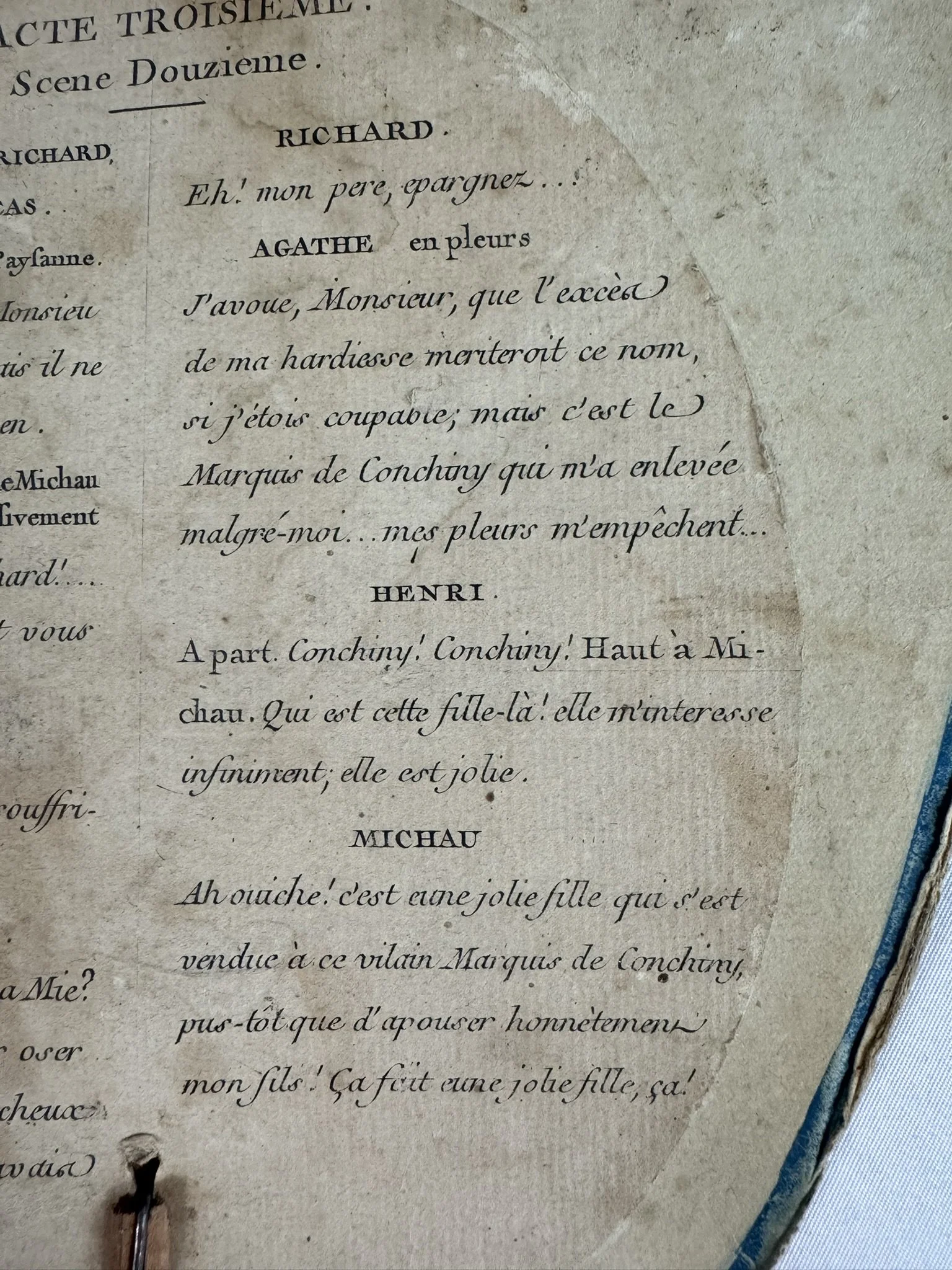 Image 6 of 6
Rare French Theatrical Hand Fire Screen — Écran à Main La Partie de Chasse de Henri IV, Charles Collé, 1766
Rare French Theatrical Hand Fire Screen — Écran à Main
La Partie de Chasse de Henri IV, Charles Collé, 1766
Engraving after Hubert-François Gravelot, engraved by Joseph de Longueil, graveur du roi
Pre-Revolutionary France, c.1766–1789
THE OBJECT
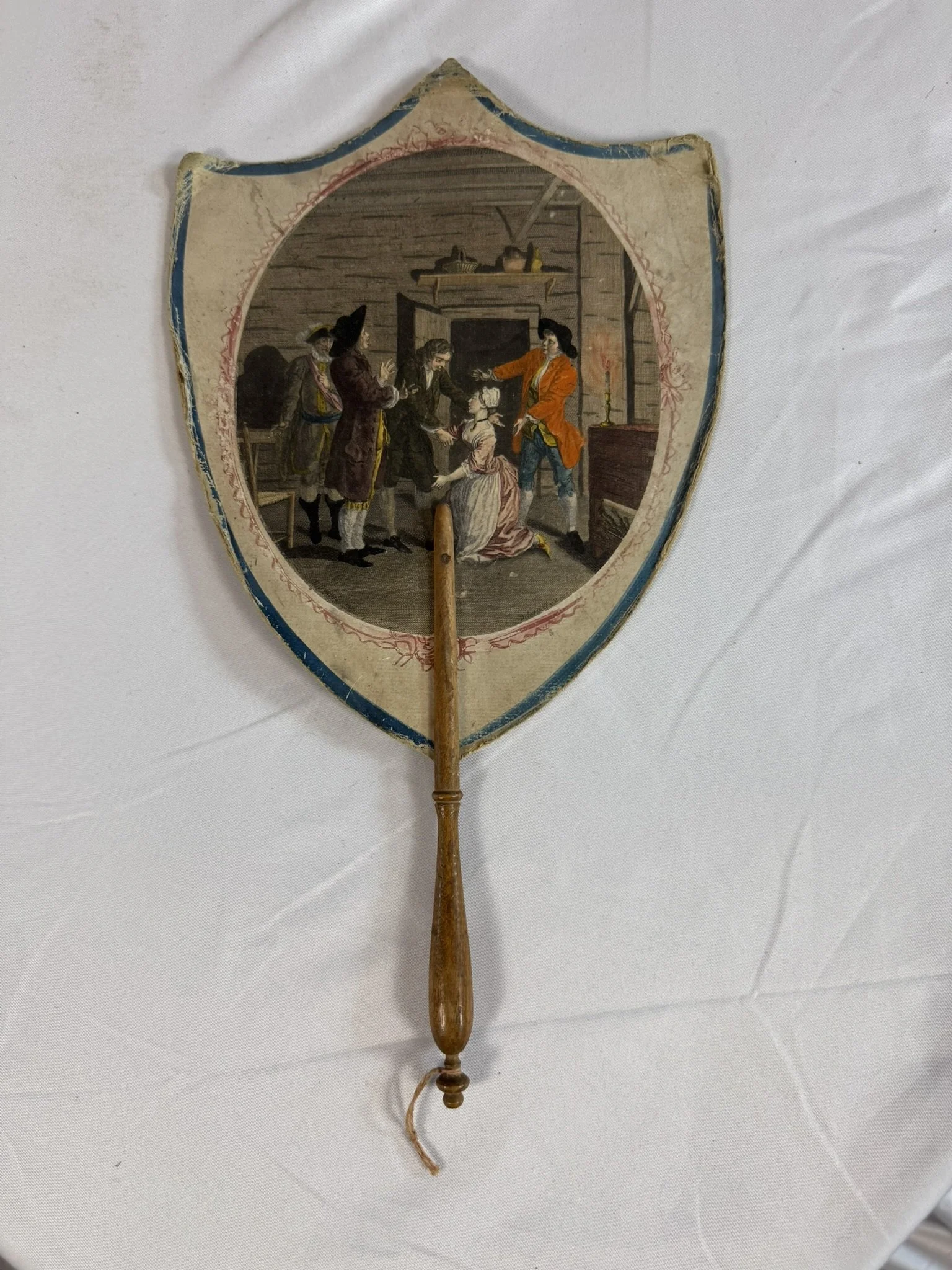
This is one of the rarest surviving categories of pre-Revolutionary French decorative ephemera: a theatrical écran à main — a hand fire screen produced as a souvenir for Parisian theatre audiences of the Ancien Régime. Its principal face bears a hand-coloured taille-douce engraving of the mill scene from Charles Collé's celebrated comedy La Partie de Chasse de Henri IV, drawn by Hubert-François Gravelot and engraved by Joseph de Longueil, graveur du roi. Its reverse carries the full printed text of Act III, Scene 12 — the climactic recognition scene of the play — set in a continuous left-to-right layout across the width of the leaf, the wooden handle traversing the centre of the text horizontally. The original cord loop remains attached to the handle. The object is complete, structurally sound, and fully legible throughout.
The écran à main was a domestic fireplace accessory of 17th and 18th century France — distinct from the fan, and now the subject of specialist scholarly study. As defined by Dr Nathalie Rizzoni (CNRS / Université Paris-Sorbonne), the leading authority in this field, these objects were produced in large quantities, distributed commercially, and generally discarded as soon as they showed signs of wear. Their fragility made them prey to damp, vermin, and fire. Intact survivals are uncommon; examples linked to a named play by identified engravers are exceptional.
THE PLAY: LA PARTIE DE CHASSE DE HENRI IV
To understand what this object is, one must understand the extraordinary cultural weight of the play it commemorates.
La Partie de Chasse de Henri IV was written by Charles Collé (1709–1783), journalist, libertine poet, and chansonnier to the Duke of Orléans. The premise is deceptively simple: Henri IV, hunting in the forest of Senlis, becomes separated from his retinue and takes shelter in the mill of an honest peasant named Michau. He spends the evening among Michau's family incognito, eating their bread, listening to their troubles, and intervening in their lives with characteristic generosity before revealing his true identity in the climactic final scene. The play has no villain. Its drama is entirely moral and sentimental — the contrast between the warmth of rural virtue and the corruption of the nobility, embodied in the wicked Marquis de Conchigny who has dishonoured Michau's household.
Collé completed the three-act version in 1762 and arranged its first performance on 8 July of that year at the private theatre of the Duke of Orléans at Bagnolet. It was immediately suppressed by royal censorship. The reason was transparent: a play showing the King of France consorting with common people, championing their dignity over aristocratic privilege, and administering justice with a humanity conspicuously absent from the court of Louis XV, was not a play the government of Louis XV wished to see performed before a public audience. It circulated in private theatres for over a decade — performed for Louis XV himself at the inauguration of Madame du Barry's pavilion at Louveciennes in September 1771, performed at Ferney for Voltaire in 1766, read and admired across the republic of letters — but remained locked out of the public stage.
The first printed edition appeared in 1766. Its title page announced what every collector of 18th-century French illustrated books will recognise as a significant production: quatre estampes en taille-douce d'après les dessins de M. Gravelot — four copper engraved plates after the drawings of Hubert-François Gravelot. Gravelot (1699–1773) was the most distinguished French book illustrator of his generation, the man who had transformed the visual culture of the 18th-century livre de luxe and whose influence on English book illustration through his years in London was equally profound. The mill scene — the recognition of Henri IV by Michau and his family — was among the most dramatically charged subjects he would ever illustrate.
The death of Louis XV on 10 May 1774 removed the obstacle at a stroke. La Partie de Chasse de Henri IV opened at the Comédie-Française on 11 November 1774 to a reception that was less a theatrical event than a political one. The audience wept. The play ran continuously. It became one of the most frequently performed comedies of the last fifteen years of the Ancien Régime, and its vision of Henri IV — accessible, just, beloved by the common people — resonated with a growing public hunger for exactly that kind of kingship. When the Revolution came, Henri IV's image would be appropriated by every faction in turn. Collé, who had died in 1783, did not live to see it.
THE FORMAT: THE THEATRICAL ÉCRAN À MAIN
The theatrical écran à main was a specific commercial format produced in Paris in the 1760s through 1780s, sold at or near the city's theatres as a souvenir of the performance. One face carried a hand-coloured engraving illustrating a scene from the play; the other carried the printed text of a key scene, enabling the holder to follow the dialogue while shielding their face from the heat and glare of the footlights.
These objects were made cheaply — their card leaves were fragile, their printed papers perishable, their intended life span short. The primary publisher identified by scholarship is Jacques-Etienne Petit, marchand papetier of Paris, whose imprint appears on several known theatrical screen series. Whether this écran bears Petit's imprint in its lower margin remains to be confirmed under magnification.
As Dr Rizzoni has established, complete series of theatrical screens linked to a single play are now of the greatest rarity. Known series include the six screens for Blaise et Babet (Monvel and Dezède, 1783), now in the collection of the Fan Museum in London; six screens for Les Deux Chasseurs et la Laitière (Anseaume and Duni, 1763), sold at Aguttes, Lyon, in 2011; and a series for Le Barbier de Séville published by Petit in 1775. The present screen, linked to La Partie de Chasse de Henri IV, is to the best of current knowledge unrecorded in the scholarly literature on this format. Its identification has been communicated to Dr Rizzoni.
THE ENGRAVING
Recto — hand-coloured taille-douce engraving within a pink-bordered oval reserve set against an ivory ground.
Dessinateur: Hubert-François Gravelot (1699–1773), known fully as Hubert-François Bourguignon d'Anville, called Gravelot. Born Paris; trained under Jean Restout and François Boucher; spent the years 1732–1745 in London where he transformed English book illustration and taught at St Martin's Lane Academy, counting Gainsborough among his students. Returned to Paris and became the pre-eminent designer of book illustrations for the great luxury editions of the French Enlightenment, working on Boccaccio, Tasso, Marmontel, Voltaire, and Rousseau. His drawings for La Partie de Chasse de Henri IV, engraved for the 1766 first edition, belong to the last decade of his career.
Graveur: Joseph de Longueil (1730–1792). Born in Givet, Ardennes, on 16 November 1730. Trained successively under Jacques Aliamet, Jacques-Philippe Le Bas, and Jean-Georges Wille — three of the most distinguished engravers in Paris. Appointed graveur du roi by royal patent on 16 September 1776; graveur du Prince de Condé in 1779. Author of over 500 documented plates, including extensive work after Gravelot, Eisen, Cochin, and Moreau le Jeune. His collaboration with Gravelot was at its height throughout the 1760s, making him the natural candidate for the mill scene plate. Signed on plates as de Longueil sculp. Grandfather of the engraver Honoré Delongueil (1818–1889).
The scene depicted is the interior of Michau the miller's house — the setting of Act III, Scene 12. Wooden plank walls enclose the space; mill machinery is visible at the right. Six figures are caught at the precise moment of dramatic revelation. At the upper left, a commanding figure in a dark brown cloak and broad-brimmed hat, seen three-quarter rear — Henri IV incognito, his true identity on the point of disclosure. At the centre, Richard the miller's son and Michau himself in a posture of stunned entreaty. In the lower foreground, a young man in a vivid orange-red coat stoops in a gesture of overwhelming emotion — recognition, shame, or relief, the composition leaves deliberately open. To the left, a woman in white and rose dress with arms raised — Agathe, the girl whose story has driven the plot to this crisis, throwing herself on the mercy of the household. In the right background, two further figures are visible near the machinery. The composition has the controlled theatricality of Gravelot at his finest: every figure is legible, every gesture narratively precise, the spatial arrangement drawing the eye inevitably toward the cloaked figure whose identity the audience already knows.
Note: the composition of this engraving does not correspond exactly to the plates in the editions consulted. It may represent a variant plate produced for separate distribution, a derivative composition after the original, or one of the four 1766 plates not yet matched. Examination of the full margin credits and any caption line will clarify this.
THE TEXT
Verso — printed text of Act III, Scene 12 of La Partie de Chasse de Henri IV, set in a single continuous left-to-right layout across the full width of the leaf. The wooden handle traverses the centre of the text horizontally. The scene heading and cast list appear on the right half; the dialogue continues across to the left. Both halves are read in normal left-to-right orientation, the screen held horizontally with the handle to the side. The text is fully legible throughout.
French original:
ACTE TROISIEME. Scene Douzieme.
HENRI, MICHAU, RICHARD, AGATHE, LUCAS.
AGATHE vêtue en Paysanne.
RICHARD:
Eh ! mon père, épargnez… !
AGATHE (en pleurs):
J'avoue, Monsieur, que l'excès de ma hardiesse mériteroit ce nom, si j'étois coupable ; mais c'est le Marquis de Conchigny qui m'a enlevée malgré-moi… mes pleurs m'empêchant infiniment…
HENRI (à part):
Conchigny, Conchigny ! (Haut à Michau) Qui est cette fille-là ; elle m'intéresse infiniment ; elle est jolie.
MICHAU:
Ah ouiche ; c'est une jolie fille qui s'est perdue à ce vilain Marquis de Conchigny, pur-être que d'épouser honnêtement mon fils ; ça fait une jolie fille, ça !
LUCAS (à Agathe vêtue en Paysanne):
Eh bien, Mamselle, le vlà Monsieur Richard, parlais-t'y donc, mais il ne vous croira pas, vantais-vous-en.
AGATHE (se jettant aux pieds de Michau et de Richard):
Ah, Monsieur Michau !… Ah, Richard !… Je viens me jetter à vos pieds, et vous supplier de m'entendre…
RICHARD (la relevant):
Relevez-vous, Agathe ;… je ne souffrirai pas…
MICHAU (à Agathe):
Oh, oh, qui vous amène ici ma Mie ? faut-il un bon impudente pour avoir encore remettre les pieds chez-nous, après ce qu'il vous a fait !
English translation:
ACT THREE, SCENE TWELVE.
Henri, Michau, Richard, Agathe, Lucas. Agathe dressed as a Peasant Girl.
RICHARD: Ah, father, spare her…!
AGATHE (in tears): I confess, Monsieur, that the excess of my boldness would deserve that name, were I guilty; but it is the Marquis de Conchigny who abducted me against my will… my tears prevent me from speaking…
HENRI (aside): Conchigny, Conchigny! (aloud to Michau) Who is this girl? She interests me greatly; she is pretty.
MICHAU: Ha! She is a pretty girl who was ruined by that wicked Marquis de Conchigny, rather than marry my son honestly; quite a girl, that is!
LUCAS (to Agathe): Well now, Mademoiselle, here is Monsieur Richard — speak up, but he will not believe you — make your case.
AGATHE (throwing herself at their feet): Ah, Monsieur Michau!… Ah, Richard!… I come to throw myself at your feet and beg you to hear me out…
RICHARD (raising her): Rise, Agathe;… I shall not allow…
MICHAU (to Agathe): Well well, what brings you here, my girl? Does it take such impudence to set foot in our house again, after what has been done to you!
PHYSICAL DESCRIPTION
Type: Single theatrical hand fire screen (écran à main de théâtre)
Play: La Partie de Chasse de Henri IV, Charles Collé, first performed 1762, first printed 1766
Text: Act III, Scene 12 — single continuous left-to-right layout across full leaf width; fully legible
Engraving: Hand-coloured taille-douce after Hubert-François Gravelot, engraved by Joseph de Longueil, graveur du roi; signed in lower margin as Gravelot inv. and de Longueil sculp.
Silhouette: Pointed leaf form (vesica)
Border: Blue ribbon outer border; pink printed foliate inner border framing the oval engraving
Handle: Turned natural wood, baluster form with small turned finial; original cord loop retained
Screen leaf: approx. 10 x 7.5 in / 25.5 x 19 cm
Total height including handle: approx. 14 in / 35.5 cm
CONDITION
The screen is sold as an antique in honest aged condition consistent with approximately 230 to 260 years of use. General foxing, toning, and surface soiling throughout, wholly consistent with the period and consistent with the known fragility of these objects. There is a significant loss or tear at the upper right corner of the leaf — clearly visible in the photographs and fully disclosed. The blue ribbon border shows fraying and losses, most prominently at the upper section. Despite these condition issues — which will be unsurprising to any specialist in this category — the printed text on the reverse remains fully legible throughout, the hand-coloured engraving retains good colour and clear definition, the handle is sound with good warm patina, and the original cord loop is intact. The object is structurally complete.
Condition issues of this nature are entirely expected in pre-Revolutionary French printed ephemera of this kind and do not diminish the historical and documentary significance of the object.
BIBLIOGRAPHY AND SCHOLARLY CONTEXT
The scholarly literature on theatrical écrans à main has been established principally by Dr Nathalie Rizzoni (CNRS / Université Paris-Sorbonne): see L'actualité dramatique à l'écran au XVIIIe siècle (Éditions MSH, 2019) and her article on the Blaise et Babet series (Collectiana, accessible online). The specialist bibliography on the format more broadly includes Letourmy, G. and Crépin, D., Le Vieux Papier, nos. 403–412 (écrans à main) and nos. 420–421 (Jacques-Etienne Petit as publisher). For Gravelot, see the standard monograph by Susan Sloman; for de Longueil, see Bénézit, Dictionnaire des peintres, sculpteurs, dessinateurs et graveurs. The identification of this screen has been communicated to Dr Rizzoni, whose response is awaited.
ENQUIRIES
This object is offered for sale by Jacob Trudaine. Enquiries are welcome and high-resolution photographs of both faces are available on request. We are happy to provide additional detail on any aspect of the description for serious collectors, institutions, and researchers.
Rare French Theatrical Hand Fire Screen — Écran à Main
La Partie de Chasse de Henri IV, Charles Collé, 1766
Engraving after Hubert-François Gravelot, engraved by Joseph de Longueil, graveur du roi
Pre-Revolutionary France, c.1766–1789
THE OBJECT
This is one of the rarest surviving categories of pre-Revolutionary French decorative ephemera: a theatrical écran à main — a hand fire screen produced as a souvenir for Parisian theatre audiences of the Ancien Régime. Its principal face bears a hand-coloured taille-douce engraving of the mill scene from Charles Collé's celebrated comedy La Partie de Chasse de Henri IV, drawn by Hubert-François Gravelot and engraved by Joseph de Longueil, graveur du roi. Its reverse carries the full printed text of Act III, Scene 12 — the climactic recognition scene of the play — set in a continuous left-to-right layout across the width of the leaf, the wooden handle traversing the centre of the text horizontally. The original cord loop remains attached to the handle. The object is complete, structurally sound, and fully legible throughout.
The écran à main was a domestic fireplace accessory of 17th and 18th century France — distinct from the fan, and now the subject of specialist scholarly study. As defined by Dr Nathalie Rizzoni (CNRS / Université Paris-Sorbonne), the leading authority in this field, these objects were produced in large quantities, distributed commercially, and generally discarded as soon as they showed signs of wear. Their fragility made them prey to damp, vermin, and fire. Intact survivals are uncommon; examples linked to a named play by identified engravers are exceptional.
THE PLAY: LA PARTIE DE CHASSE DE HENRI IV
To understand what this object is, one must understand the extraordinary cultural weight of the play it commemorates.
La Partie de Chasse de Henri IV was written by Charles Collé (1709–1783), journalist, libertine poet, and chansonnier to the Duke of Orléans. The premise is deceptively simple: Henri IV, hunting in the forest of Senlis, becomes separated from his retinue and takes shelter in the mill of an honest peasant named Michau. He spends the evening among Michau's family incognito, eating their bread, listening to their troubles, and intervening in their lives with characteristic generosity before revealing his true identity in the climactic final scene. The play has no villain. Its drama is entirely moral and sentimental — the contrast between the warmth of rural virtue and the corruption of the nobility, embodied in the wicked Marquis de Conchigny who has dishonoured Michau's household.
Collé completed the three-act version in 1762 and arranged its first performance on 8 July of that year at the private theatre of the Duke of Orléans at Bagnolet. It was immediately suppressed by royal censorship. The reason was transparent: a play showing the King of France consorting with common people, championing their dignity over aristocratic privilege, and administering justice with a humanity conspicuously absent from the court of Louis XV, was not a play the government of Louis XV wished to see performed before a public audience. It circulated in private theatres for over a decade — performed for Louis XV himself at the inauguration of Madame du Barry's pavilion at Louveciennes in September 1771, performed at Ferney for Voltaire in 1766, read and admired across the republic of letters — but remained locked out of the public stage.
The first printed edition appeared in 1766. Its title page announced what every collector of 18th-century French illustrated books will recognise as a significant production: quatre estampes en taille-douce d'après les dessins de M. Gravelot — four copper engraved plates after the drawings of Hubert-François Gravelot. Gravelot (1699–1773) was the most distinguished French book illustrator of his generation, the man who had transformed the visual culture of the 18th-century livre de luxe and whose influence on English book illustration through his years in London was equally profound. The mill scene — the recognition of Henri IV by Michau and his family — was among the most dramatically charged subjects he would ever illustrate.
The death of Louis XV on 10 May 1774 removed the obstacle at a stroke. La Partie de Chasse de Henri IV opened at the Comédie-Française on 11 November 1774 to a reception that was less a theatrical event than a political one. The audience wept. The play ran continuously. It became one of the most frequently performed comedies of the last fifteen years of the Ancien Régime, and its vision of Henri IV — accessible, just, beloved by the common people — resonated with a growing public hunger for exactly that kind of kingship. When the Revolution came, Henri IV's image would be appropriated by every faction in turn. Collé, who had died in 1783, did not live to see it.
THE FORMAT: THE THEATRICAL ÉCRAN À MAIN
The theatrical écran à main was a specific commercial format produced in Paris in the 1760s through 1780s, sold at or near the city's theatres as a souvenir of the performance. One face carried a hand-coloured engraving illustrating a scene from the play; the other carried the printed text of a key scene, enabling the holder to follow the dialogue while shielding their face from the heat and glare of the footlights.
These objects were made cheaply — their card leaves were fragile, their printed papers perishable, their intended life span short. The primary publisher identified by scholarship is Jacques-Etienne Petit, marchand papetier of Paris, whose imprint appears on several known theatrical screen series. Whether this écran bears Petit's imprint in its lower margin remains to be confirmed under magnification.
As Dr Rizzoni has established, complete series of theatrical screens linked to a single play are now of the greatest rarity. Known series include the six screens for Blaise et Babet (Monvel and Dezède, 1783), now in the collection of the Fan Museum in London; six screens for Les Deux Chasseurs et la Laitière (Anseaume and Duni, 1763), sold at Aguttes, Lyon, in 2011; and a series for Le Barbier de Séville published by Petit in 1775. The present screen, linked to La Partie de Chasse de Henri IV, is to the best of current knowledge unrecorded in the scholarly literature on this format. Its identification has been communicated to Dr Rizzoni.
THE ENGRAVING
Recto — hand-coloured taille-douce engraving within a pink-bordered oval reserve set against an ivory ground.
Dessinateur: Hubert-François Gravelot (1699–1773), known fully as Hubert-François Bourguignon d'Anville, called Gravelot. Born Paris; trained under Jean Restout and François Boucher; spent the years 1732–1745 in London where he transformed English book illustration and taught at St Martin's Lane Academy, counting Gainsborough among his students. Returned to Paris and became the pre-eminent designer of book illustrations for the great luxury editions of the French Enlightenment, working on Boccaccio, Tasso, Marmontel, Voltaire, and Rousseau. His drawings for La Partie de Chasse de Henri IV, engraved for the 1766 first edition, belong to the last decade of his career.
Graveur: Joseph de Longueil (1730–1792). Born in Givet, Ardennes, on 16 November 1730. Trained successively under Jacques Aliamet, Jacques-Philippe Le Bas, and Jean-Georges Wille — three of the most distinguished engravers in Paris. Appointed graveur du roi by royal patent on 16 September 1776; graveur du Prince de Condé in 1779. Author of over 500 documented plates, including extensive work after Gravelot, Eisen, Cochin, and Moreau le Jeune. His collaboration with Gravelot was at its height throughout the 1760s, making him the natural candidate for the mill scene plate. Signed on plates as de Longueil sculp. Grandfather of the engraver Honoré Delongueil (1818–1889).
The scene depicted is the interior of Michau the miller's house — the setting of Act III, Scene 12. Wooden plank walls enclose the space; mill machinery is visible at the right. Six figures are caught at the precise moment of dramatic revelation. At the upper left, a commanding figure in a dark brown cloak and broad-brimmed hat, seen three-quarter rear — Henri IV incognito, his true identity on the point of disclosure. At the centre, Richard the miller's son and Michau himself in a posture of stunned entreaty. In the lower foreground, a young man in a vivid orange-red coat stoops in a gesture of overwhelming emotion — recognition, shame, or relief, the composition leaves deliberately open. To the left, a woman in white and rose dress with arms raised — Agathe, the girl whose story has driven the plot to this crisis, throwing herself on the mercy of the household. In the right background, two further figures are visible near the machinery. The composition has the controlled theatricality of Gravelot at his finest: every figure is legible, every gesture narratively precise, the spatial arrangement drawing the eye inevitably toward the cloaked figure whose identity the audience already knows.
Note: the composition of this engraving does not correspond exactly to the plates in the editions consulted. It may represent a variant plate produced for separate distribution, a derivative composition after the original, or one of the four 1766 plates not yet matched. Examination of the full margin credits and any caption line will clarify this.
THE TEXT
Verso — printed text of Act III, Scene 12 of La Partie de Chasse de Henri IV, set in a single continuous left-to-right layout across the full width of the leaf. The wooden handle traverses the centre of the text horizontally. The scene heading and cast list appear on the right half; the dialogue continues across to the left. Both halves are read in normal left-to-right orientation, the screen held horizontally with the handle to the side. The text is fully legible throughout.
French original:
ACTE TROISIEME. Scene Douzieme.
HENRI, MICHAU, RICHARD, AGATHE, LUCAS.
AGATHE vêtue en Paysanne.
RICHARD:
Eh ! mon père, épargnez… !
AGATHE (en pleurs):
J'avoue, Monsieur, que l'excès de ma hardiesse mériteroit ce nom, si j'étois coupable ; mais c'est le Marquis de Conchigny qui m'a enlevée malgré-moi… mes pleurs m'empêchant infiniment…
HENRI (à part):
Conchigny, Conchigny ! (Haut à Michau) Qui est cette fille-là ; elle m'intéresse infiniment ; elle est jolie.
MICHAU:
Ah ouiche ; c'est une jolie fille qui s'est perdue à ce vilain Marquis de Conchigny, pur-être que d'épouser honnêtement mon fils ; ça fait une jolie fille, ça !
LUCAS (à Agathe vêtue en Paysanne):
Eh bien, Mamselle, le vlà Monsieur Richard, parlais-t'y donc, mais il ne vous croira pas, vantais-vous-en.
AGATHE (se jettant aux pieds de Michau et de Richard):
Ah, Monsieur Michau !… Ah, Richard !… Je viens me jetter à vos pieds, et vous supplier de m'entendre…
RICHARD (la relevant):
Relevez-vous, Agathe ;… je ne souffrirai pas…
MICHAU (à Agathe):
Oh, oh, qui vous amène ici ma Mie ? faut-il un bon impudente pour avoir encore remettre les pieds chez-nous, après ce qu'il vous a fait !
English translation:
ACT THREE, SCENE TWELVE.
Henri, Michau, Richard, Agathe, Lucas. Agathe dressed as a Peasant Girl.
RICHARD: Ah, father, spare her…!
AGATHE (in tears): I confess, Monsieur, that the excess of my boldness would deserve that name, were I guilty; but it is the Marquis de Conchigny who abducted me against my will… my tears prevent me from speaking…
HENRI (aside): Conchigny, Conchigny! (aloud to Michau) Who is this girl? She interests me greatly; she is pretty.
MICHAU: Ha! She is a pretty girl who was ruined by that wicked Marquis de Conchigny, rather than marry my son honestly; quite a girl, that is!
LUCAS (to Agathe): Well now, Mademoiselle, here is Monsieur Richard — speak up, but he will not believe you — make your case.
AGATHE (throwing herself at their feet): Ah, Monsieur Michau!… Ah, Richard!… I come to throw myself at your feet and beg you to hear me out…
RICHARD (raising her): Rise, Agathe;… I shall not allow…
MICHAU (to Agathe): Well well, what brings you here, my girl? Does it take such impudence to set foot in our house again, after what has been done to you!
PHYSICAL DESCRIPTION
Type: Single theatrical hand fire screen (écran à main de théâtre)
Play: La Partie de Chasse de Henri IV, Charles Collé, first performed 1762, first printed 1766
Text: Act III, Scene 12 — single continuous left-to-right layout across full leaf width; fully legible
Engraving: Hand-coloured taille-douce after Hubert-François Gravelot, engraved by Joseph de Longueil, graveur du roi; signed in lower margin as Gravelot inv. and de Longueil sculp.
Silhouette: Pointed leaf form (vesica)
Border: Blue ribbon outer border; pink printed foliate inner border framing the oval engraving
Handle: Turned natural wood, baluster form with small turned finial; original cord loop retained
Screen leaf: approx. 10 x 7.5 in / 25.5 x 19 cm
Total height including handle: approx. 14 in / 35.5 cm
CONDITION
The screen is sold as an antique in honest aged condition consistent with approximately 230 to 260 years of use. General foxing, toning, and surface soiling throughout, wholly consistent with the period and consistent with the known fragility of these objects. There is a significant loss or tear at the upper right corner of the leaf — clearly visible in the photographs and fully disclosed. The blue ribbon border shows fraying and losses, most prominently at the upper section. Despite these condition issues — which will be unsurprising to any specialist in this category — the printed text on the reverse remains fully legible throughout, the hand-coloured engraving retains good colour and clear definition, the handle is sound with good warm patina, and the original cord loop is intact. The object is structurally complete.
Condition issues of this nature are entirely expected in pre-Revolutionary French printed ephemera of this kind and do not diminish the historical and documentary significance of the object.
BIBLIOGRAPHY AND SCHOLARLY CONTEXT
The scholarly literature on theatrical écrans à main has been established principally by Dr Nathalie Rizzoni (CNRS / Université Paris-Sorbonne): see L'actualité dramatique à l'écran au XVIIIe siècle (Éditions MSH, 2019) and her article on the Blaise et Babet series (Collectiana, accessible online). The specialist bibliography on the format more broadly includes Letourmy, G. and Crépin, D., Le Vieux Papier, nos. 403–412 (écrans à main) and nos. 420–421 (Jacques-Etienne Petit as publisher). For Gravelot, see the standard monograph by Susan Sloman; for de Longueil, see Bénézit, Dictionnaire des peintres, sculpteurs, dessinateurs et graveurs. The identification of this screen has been communicated to Dr Rizzoni, whose response is awaited.
ENQUIRIES
This object is offered for sale by Jacob Trudaine. Enquiries are welcome and high-resolution photographs of both faces are available on request. We are happy to provide additional detail on any aspect of the description for serious collectors, institutions, and researchers.