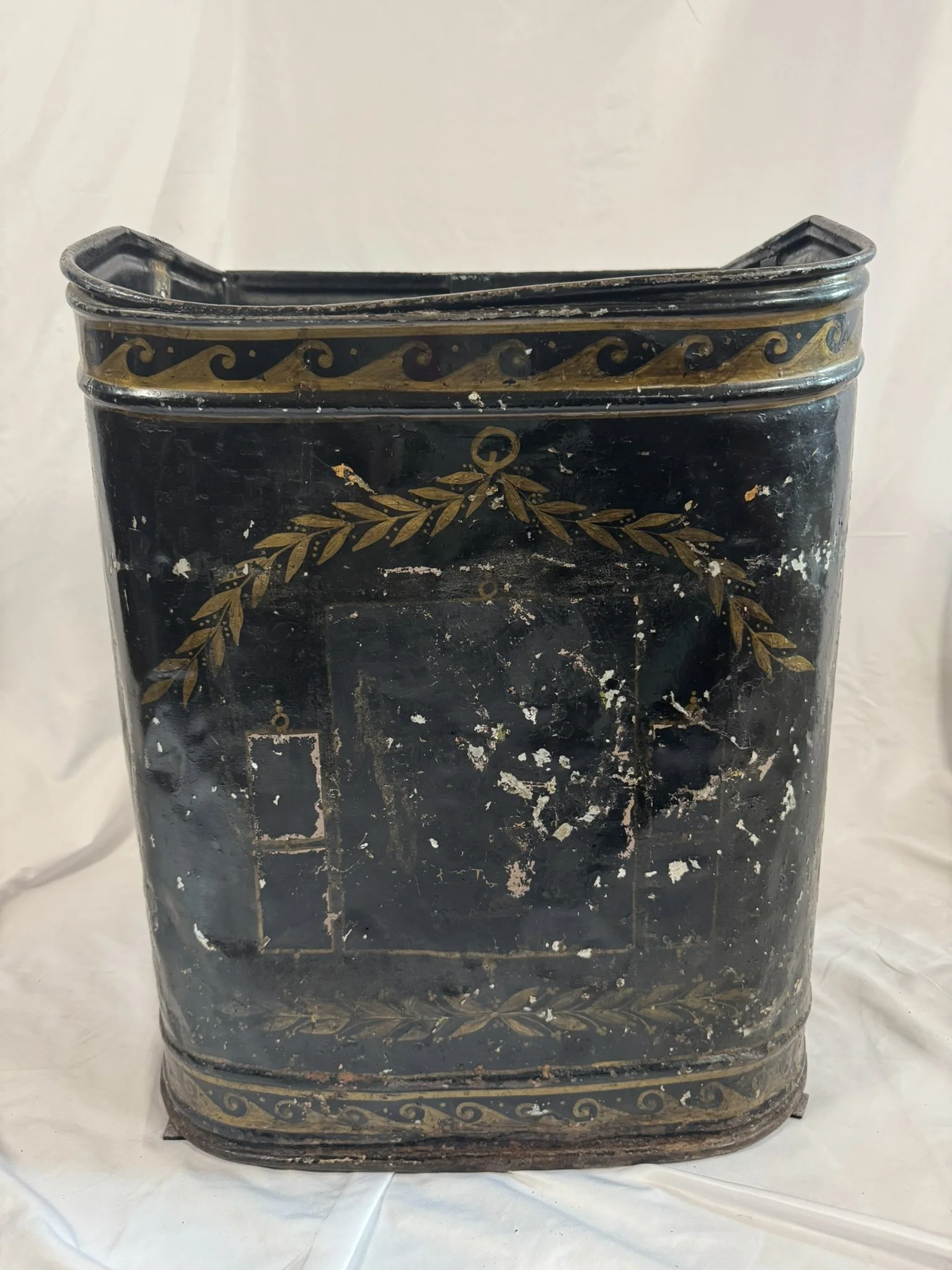
There's a wonderful graphic drama to this one: a black japanned coal helmet scuttle with gilt laurel swags, scrolling borders, and a central roundel of cherubs playing with a bird and a flower urn. It's the kind of Victorian fireside piece that was made to be looked at as much as used.
Flip it over and there's a diamond-shaped mark stamped right into the base reading Beldray, a real English tin and metalware manufacturer, alongside "Longcliffe."
Construction and design notes:
- Helmet-form black japanned tole body, scooped front, pointed sloped back
- Two riveted iron carrying handles
- Gilt laurel swags, scrollwork borders, and a central cherub roundel
- Diamond embossed maker's mark on the base
Label / mark transcription (exact):
Diamond-shaped embossed mark (base): "BELDRAY / LONGCLIFFE / BELDRAY"
Note: a matching black japanned tole coal bin with the same gilt cherub-roundel and laurel decoration, carrying a separate "Parnall & Sons Ltd" Bristol retailer's plaque, is listed as a companion piece — see the coal bin listing.
Flat measurements: height 24 in (61 cm); base approximately 10 in diameter, tapering (25.4 cm).
Sold as-is: there's extensive flaking and paint loss across several panels, scattered white speckling and some larger bare patches down to the metal. The gilt decoration still reads beautifully despite this, and the body and handles feel structurally sound throughout.
A great find for a collector of English tole ware or fireside antiques, or anyone wanting a bold black-and-gilt piece with real history and a legible maker's mark. A matching coal bin, decorated identically, is also available, see that listing if you'd like the pair. Origin: England. Era: Victorian, 19th century (a stylistic read; Beldray's documented history as an English metalware maker supports this general period, though the specific decade isn't independently confirmed). Materials: painted tin (tole) with gilt decoration, iron handles. Care: dust gently, keep away from moisture, and please don't touch up the paint losses yourself, a conservator's opinion is worth getting first if you want to address them at all.


There's a wonderful graphic drama to this one: a black japanned coal helmet scuttle with gilt laurel swags, scrolling borders, and a central roundel of cherubs playing with a bird and a flower urn. It's the kind of Victorian fireside piece that was made to be looked at as much as used.
Flip it over and there's a diamond-shaped mark stamped right into the base reading Beldray, a real English tin and metalware manufacturer, alongside "Longcliffe."
Construction and design notes:
- Helmet-form black japanned tole body, scooped front, pointed sloped back
- Two riveted iron carrying handles
- Gilt laurel swags, scrollwork borders, and a central cherub roundel
- Diamond embossed maker's mark on the base
Label / mark transcription (exact):
Diamond-shaped embossed mark (base): "BELDRAY / LONGCLIFFE / BELDRAY"
Note: a matching black japanned tole coal bin with the same gilt cherub-roundel and laurel decoration, carrying a separate "Parnall & Sons Ltd" Bristol retailer's plaque, is listed as a companion piece — see the coal bin listing.
Flat measurements: height 24 in (61 cm); base approximately 10 in diameter, tapering (25.4 cm).
Sold as-is: there's extensive flaking and paint loss across several panels, scattered white speckling and some larger bare patches down to the metal. The gilt decoration still reads beautifully despite this, and the body and handles feel structurally sound throughout.
A great find for a collector of English tole ware or fireside antiques, or anyone wanting a bold black-and-gilt piece with real history and a legible maker's mark. A matching coal bin, decorated identically, is also available, see that listing if you'd like the pair. Origin: England. Era: Victorian, 19th century (a stylistic read; Beldray's documented history as an English metalware maker supports this general period, though the specific decade isn't independently confirmed). Materials: painted tin (tole) with gilt decoration, iron handles. Care: dust gently, keep away from moisture, and please don't touch up the paint losses yourself, a conservator's opinion is worth getting first if you want to address them at all.