Antique French Hand-Colored Engravings by Boilly | "Point de Convention", "La Folie du Jour"
Pair of Antique French Hand-Colored Engravings After Louis-Léopold Boilly | "Point de Convention" & "La Folie du Jour" | E. Bussière Paris | c.1795–1810 | 10.5"x9" Framed
Item Description:
A rare and highly collectible pair of antique French hand-colored engravings after works by Louis-Léopold Boilly (1761–1845), one of the most celebrated and beloved French painters of Parisian daily life. Boilly's genre scenes of Revolutionary, Directoire, and Consulate-era Paris are among the most historically important and sought-after French prints of the early 19th century, documenting with unmatched wit and precision the manners, fashions, and social customs of his time.
Both prints bear the stamp of E. Bussière, Marchande de Tableaux, 24 Rue des Dames, Paris — a documented Parisian print and art dealer — confirming their genuine period Parisian origin and provenance.
PRINT 1 — "Point de Convention" (Hand-colored engraving after Louis-Léopold Boilly)
"Point de Convention" — meaning "No Standing on Ceremony" — is one of Boilly's most celebrated and historically resonant Directoire social scenes. The print depicts a satirical and risqué encounter in which an Incroyable — one of the wildly fashionable young dandies who dominated Parisian street life after the fall of Robespierre — mistakes an elegantly dressed Merveilleuse for a prostitute and offers her a coin. The lady, deeply offended, refuses and crosses her fingers in a gesture of contempt and denial — a wonderfully observed moment of social comedy and misread social signals in the chaotic post-Revolutionary city.
The scene is a masterful document of the extreme fashion excesses of the Directoire period (1795–1799):
The Incroyable is depicted in his characteristic costume — enormously exaggerated cravat wound high around the neck, tight knee breeches, oversized lapels, bicorne hat carried in hand, and riding cane — the uniform of the post-Terror dandy set who rejoiced in flouting revolutionary austerity with theatrical excess. Some Incroyables, known as Muscadins for their heavy musk perfume, had a darker side, organizing into bands to harass remaining Jacobins with their distinctive bludgeons and canes.
The Merveilleuse wears the most audacious fashion of the age — a virtually transparent gauze classical-style gown inspired by ancient Greek and Roman dress, adopted by fashionable young women of post-Revolutionary Paris as a deliberate rejection of all pre-Revolutionary convention. Dampened to cling to the body and worn over minimal undergarments, these extraordinary garments scandalized conservative observers while becoming the defining symbol of Directoire female fashion liberation.
A bootblack crouches at the gentleman's feet — a wonderfully observed social detail grounding this scene of high-fashion absurdity in the real streets of Paris.
PRINT 2 — "La Folie du Jour" (Hand-colored engraving after Louis-Léopold Boilly)
"La Folie du Jour" — The Madness of the Day — captures the extraordinary dance fever that swept Parisian society during the Directoire period. After the end of the Terror, hundreds of dance halls opened across Paris and frenetic new dances became a symbol of post-Revolutionary liberation and joi de vivre. Boilly depicts a couple of Incroyables and Merveilleuses dancing exuberantly — the lady in her characteristic diaphanous Empire gown, her partner in full Incroyable dandy dress — while a disheveled elderly violinist plays with passionate abandon on his low stool, wine bottles scattered at his feet. The wonderful contrast between the vigorous, fashionable young dancers and the world-weary musician is quintessential Boilly — humorous, warm, and acutely observed.
About Louis-Léopold Boilly (1761–1845):
Born in La Bassée near Lille, Boilly moved to Paris where he became the preeminent chronicler of Parisian bourgeois and street life across six decades of turbulent French history. His genre paintings and prints — depicting crowds, theaters, games, dances, and social encounters — are held in the Louvre, the Musée Carnavalet, the Hermitage, and major collections worldwide. Prints after his works were enormously popular during his lifetime and remain highly collectible today. His Directoire-era scenes in particular are prized as primary visual documents of one of the most dramatic periods in French history.
Features:
Hand-colored engravings after Louis-Léopold Boilly — confirmed attribution
Superb period hand coloring in soft naturalistic palette
Fine engraved detail throughout — costumes, expressions, accessories
E. Bussière, 24 Rue des Dames, Paris dealer stamp on verso
Double brown mat with gilt inner border
Protected under glass in matching blue wood surrounding .
Sold as a matched pair
Dimensions:
Framed: 10.5" x 9" each
Print image: 5.5" x 7.5" each
Condition: Antique — age-toning and minor foxing consistent with 200+ years of age; hand coloring remains vibrant; prints display beautifully; frames show wear consistent with age
Perfect for: Collectors of French Old Master prints, Boilly collectors, Directoire/Napoleonic era enthusiasts, French social history scholars, costume history researchers, or as a distinguished pair of antique prints for a period interior
Pair of Antique French Hand-Colored Engravings After Louis-Léopold Boilly | "Point de Convention" & "La Folie du Jour" | E. Bussière Paris | c.1795–1810 | 10.5"x9" Framed
Item Description:
A rare and highly collectible pair of antique French hand-colored engravings after works by Louis-Léopold Boilly (1761–1845), one of the most celebrated and beloved French painters of Parisian daily life. Boilly's genre scenes of Revolutionary, Directoire, and Consulate-era Paris are among the most historically important and sought-after French prints of the early 19th century, documenting with unmatched wit and precision the manners, fashions, and social customs of his time.
Both prints bear the stamp of E. Bussière, Marchande de Tableaux, 24 Rue des Dames, Paris — a documented Parisian print and art dealer — confirming their genuine period Parisian origin and provenance.
PRINT 1 — "Point de Convention" (Hand-colored engraving after Louis-Léopold Boilly)
"Point de Convention" — meaning "No Standing on Ceremony" — is one of Boilly's most celebrated and historically resonant Directoire social scenes. The print depicts a satirical and risqué encounter in which an Incroyable — one of the wildly fashionable young dandies who dominated Parisian street life after the fall of Robespierre — mistakes an elegantly dressed Merveilleuse for a prostitute and offers her a coin. The lady, deeply offended, refuses and crosses her fingers in a gesture of contempt and denial — a wonderfully observed moment of social comedy and misread social signals in the chaotic post-Revolutionary city.
The scene is a masterful document of the extreme fashion excesses of the Directoire period (1795–1799):
The Incroyable is depicted in his characteristic costume — enormously exaggerated cravat wound high around the neck, tight knee breeches, oversized lapels, bicorne hat carried in hand, and riding cane — the uniform of the post-Terror dandy set who rejoiced in flouting revolutionary austerity with theatrical excess. Some Incroyables, known as Muscadins for their heavy musk perfume, had a darker side, organizing into bands to harass remaining Jacobins with their distinctive bludgeons and canes.
The Merveilleuse wears the most audacious fashion of the age — a virtually transparent gauze classical-style gown inspired by ancient Greek and Roman dress, adopted by fashionable young women of post-Revolutionary Paris as a deliberate rejection of all pre-Revolutionary convention. Dampened to cling to the body and worn over minimal undergarments, these extraordinary garments scandalized conservative observers while becoming the defining symbol of Directoire female fashion liberation.
A bootblack crouches at the gentleman's feet — a wonderfully observed social detail grounding this scene of high-fashion absurdity in the real streets of Paris.
PRINT 2 — "La Folie du Jour" (Hand-colored engraving after Louis-Léopold Boilly)
"La Folie du Jour" — The Madness of the Day — captures the extraordinary dance fever that swept Parisian society during the Directoire period. After the end of the Terror, hundreds of dance halls opened across Paris and frenetic new dances became a symbol of post-Revolutionary liberation and joi de vivre. Boilly depicts a couple of Incroyables and Merveilleuses dancing exuberantly — the lady in her characteristic diaphanous Empire gown, her partner in full Incroyable dandy dress — while a disheveled elderly violinist plays with passionate abandon on his low stool, wine bottles scattered at his feet. The wonderful contrast between the vigorous, fashionable young dancers and the world-weary musician is quintessential Boilly — humorous, warm, and acutely observed.
About Louis-Léopold Boilly (1761–1845):
Born in La Bassée near Lille, Boilly moved to Paris where he became the preeminent chronicler of Parisian bourgeois and street life across six decades of turbulent French history. His genre paintings and prints — depicting crowds, theaters, games, dances, and social encounters — are held in the Louvre, the Musée Carnavalet, the Hermitage, and major collections worldwide. Prints after his works were enormously popular during his lifetime and remain highly collectible today. His Directoire-era scenes in particular are prized as primary visual documents of one of the most dramatic periods in French history.
Features:
Hand-colored engravings after Louis-Léopold Boilly — confirmed attribution
Superb period hand coloring in soft naturalistic palette
Fine engraved detail throughout — costumes, expressions, accessories
E. Bussière, 24 Rue des Dames, Paris dealer stamp on verso
Double brown mat with gilt inner border
Protected under glass in matching blue wood surrounding .
Sold as a matched pair
Dimensions:
Framed: 10.5" x 9" each
Print image: 5.5" x 7.5" each
Condition: Antique — age-toning and minor foxing consistent with 200+ years of age; hand coloring remains vibrant; prints display beautifully; frames show wear consistent with age
Perfect for: Collectors of French Old Master prints, Boilly collectors, Directoire/Napoleonic era enthusiasts, French social history scholars, costume history researchers, or as a distinguished pair of antique prints for a period interior

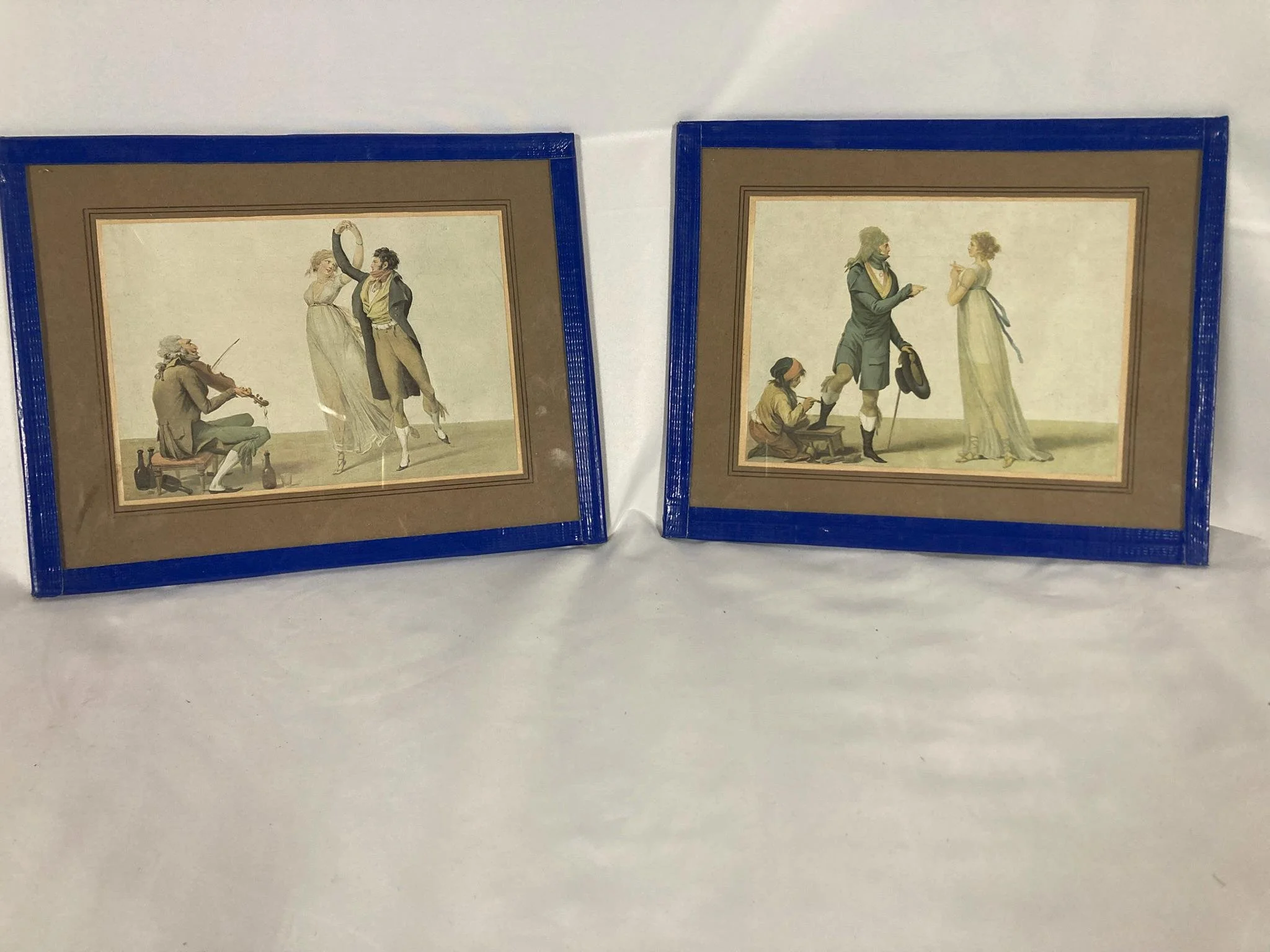 Image 1 of 5
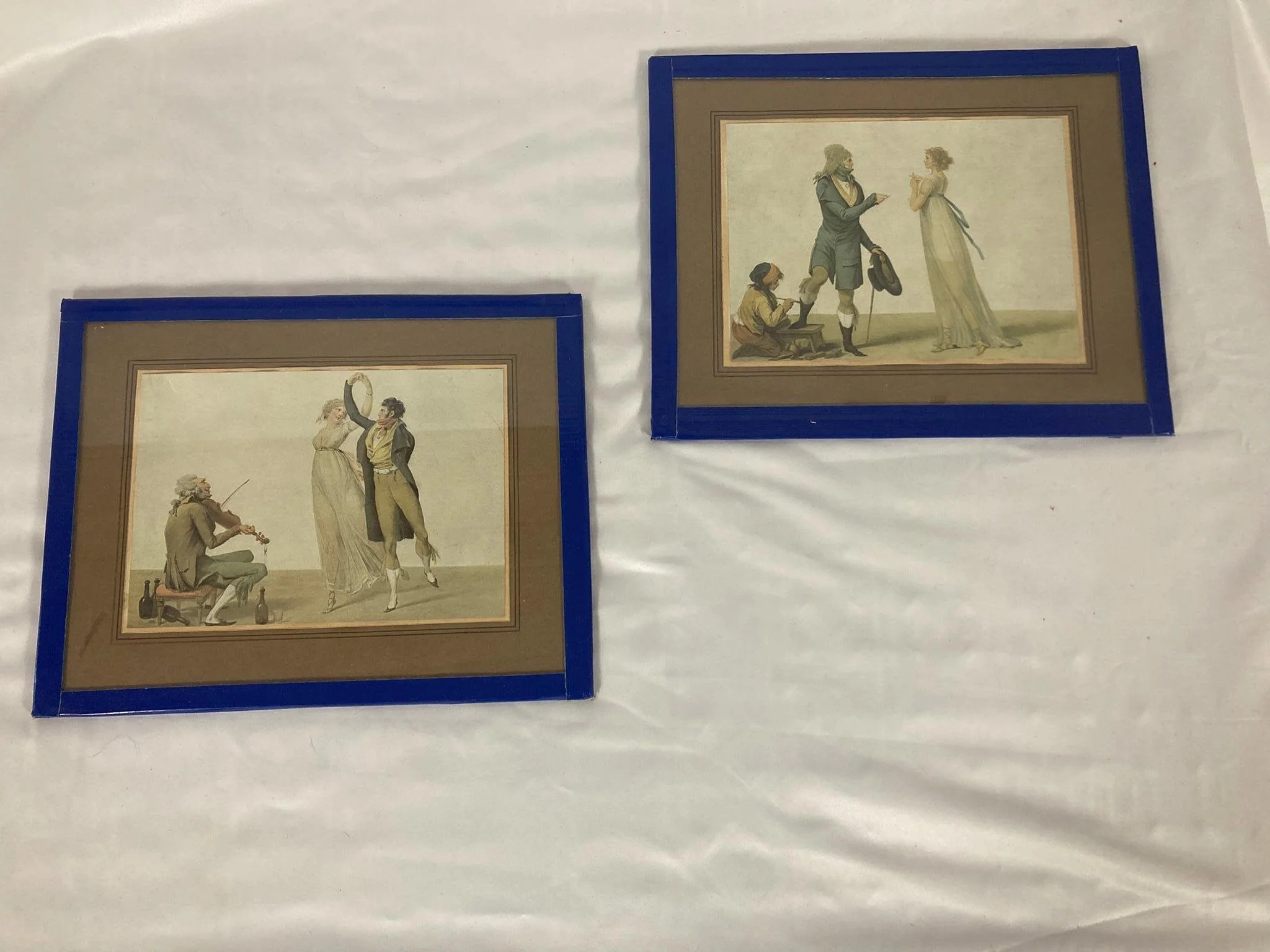 Image 2 of 5
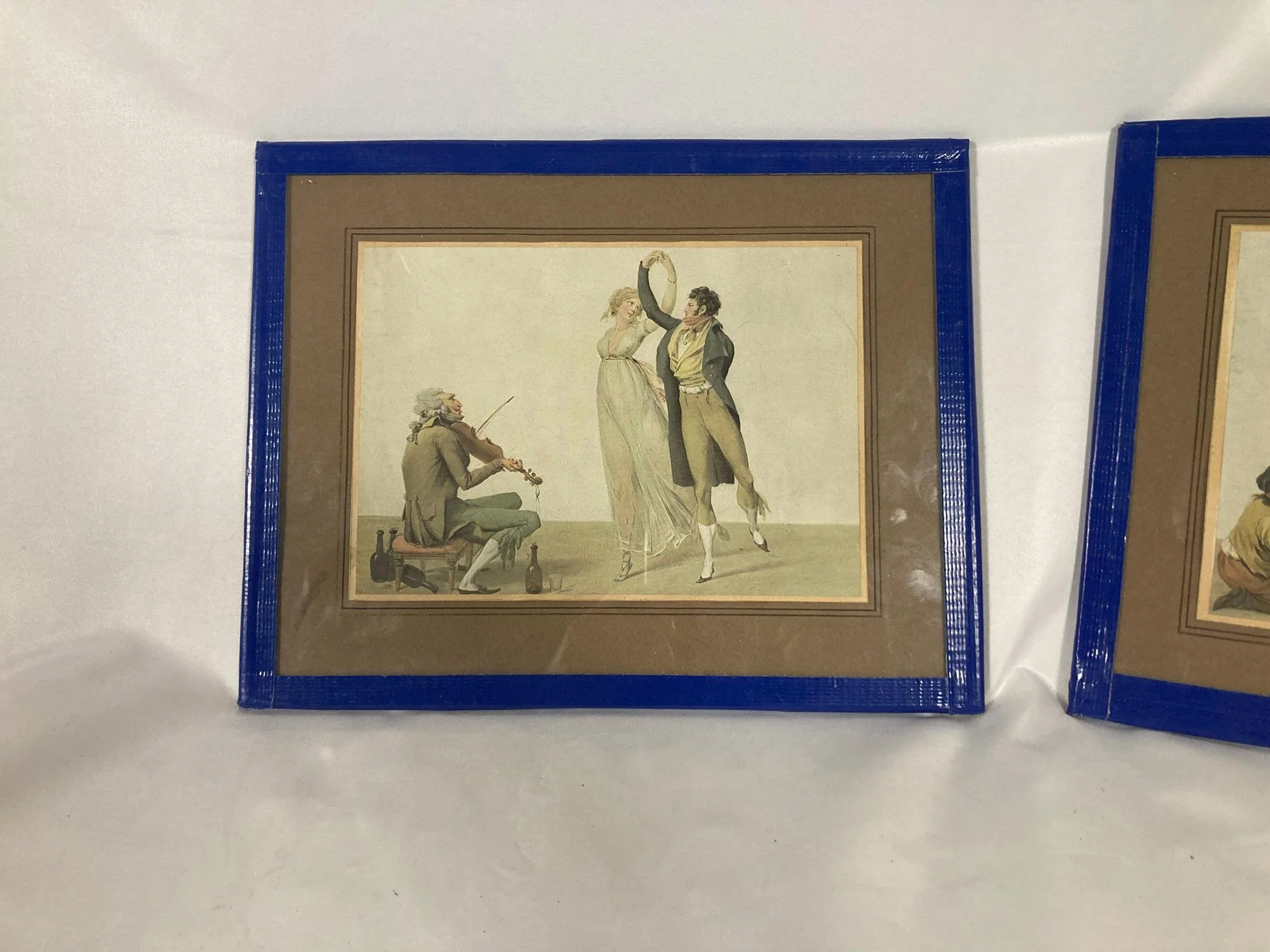 Image 3 of 5
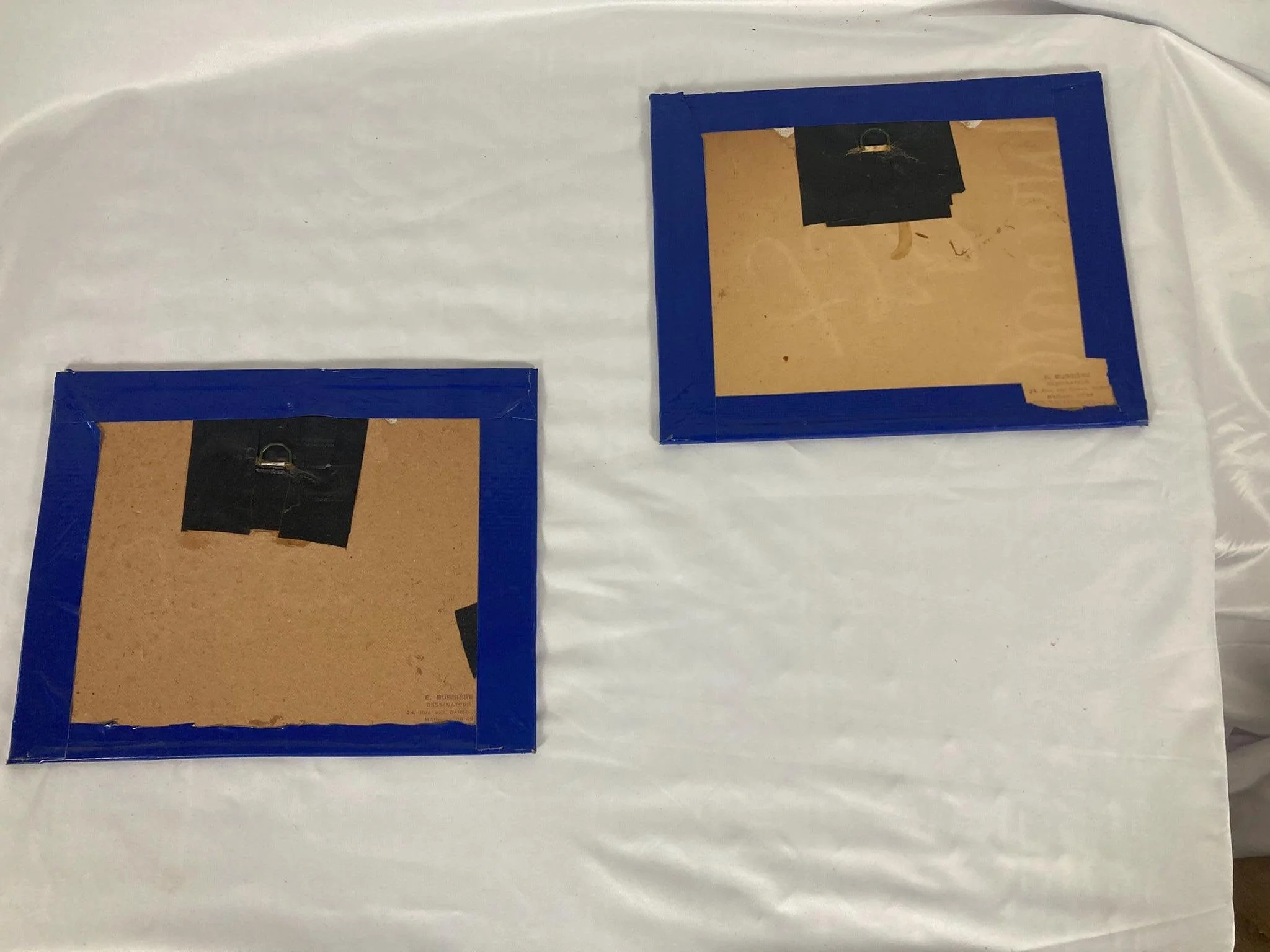 Image 4 of 5
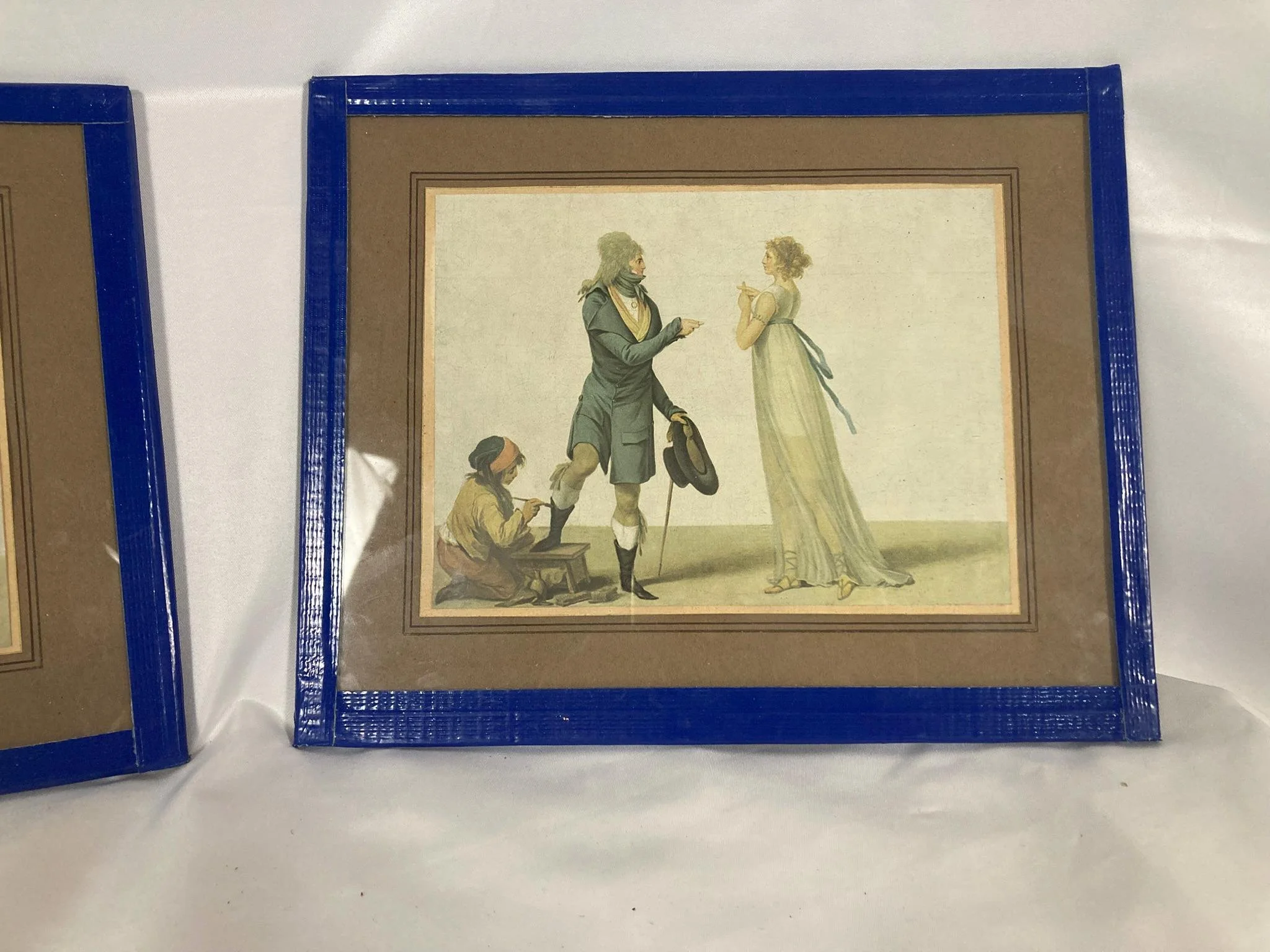 Image 5 of 5